

It is fascinating to think that in 2026, our workdays will be defined by orchestrating AI agents, optimizing cloud-native environments, and deploying self-healing security protocols. But if we rewind exactly 40 years to 1986, business technology wasn’t just “retro,” it was a different reality entirely.
In 1986, the cloud was something that ruined your Saturday tee time, not a place where you stored your database. Here is what the cutting edge looked like when high-tech involved a lot more physical heavy lifting.
The Desktop: Heavy, Loud, and Low-Res
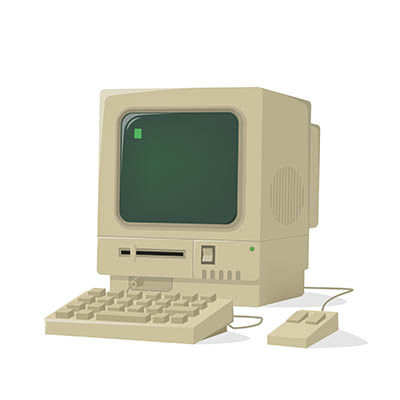
In 1986, the personal computer was finally gaining a foothold in the corporate cubicle, but it bore no resemblance to the paper-thin, silent workstations we use today.
The Powerhouses
The IBM PC XT and the Compaq Deskpro 386 were the gold standard. A blazing fast machine ran at 16 MHz (roughly 200 times slower than a modern budget smartphone) and featured a massive 40 MB hard drive.
The View
Forget 4K OLED. You were likely staring at a flickering CGA or EGA monitor capable of 16 colors. More often than not, you were working in green screen monochrome, where every line of text felt like a scene from The Matrix.
The Storage
Floppy disks were actually floppy. The 5.25-inch disk held about 360 KB. To move a large project, you didn’t share a link; you carried a plastic box of disks across the office like a deck of cards.
The Software Suites: No Mice, Just Muscle Memory
There was no auto-save, no real-time collaboration, and certainly no undo for your work life. If two people needed to edit a document, they traded a physical seat at the desk.
WordPerfect was the titan of word processing. It offered a blank blue screen where users had to memorize complex Function Key combinations just to perform basic tasks like bolding or underlining text. Meanwhile, Lotus 1-2-3 was the killer app of the era—it was the primary reason CEOs finally agreed that businesses actually needed computers.
Underpinning it all was MS-DOS 3.2. There was no clicking or dragging; you typed everything. To move a file or see a list of documents, you had to master commands like DIR, COPY, and DEL. While Windows 1.0 had been released, most professionals in 1986 dismissed it as a slow, clunky novelty.
The Pre-Internet Dark Ages
For anyone who started their career in the 2010s or 2020s, this is the hardest part to grasp: The office was an island.
The Memo vs. The Email
While internal email existed on massive mainframes, most communication was physical. You typed a memo, printed it on a Dot Matrix printer (the loud ones with the perforated tractor-feed paper edges), and dropped it in a physical In-Box.
The Fax Revolution
1986 was the dawn of the fax machine. At the time, sending a grainy, thermal-paper image over a phone line in 60 seconds was considered absolute sorcery.
The Google of 1986
If you hit a technical snag, you didn’t search a forum. You pulled a 400-page printed manual off a shelf or found the guy who had been there for twenty years and took him to lunch.
The IT Professional as a Mechanic
Back then, being an IT Guy meant being a literal hardware mechanic. Your day-to-day involved:
- Configuring Jumpers – Manually flipping tiny pins on circuit boards to tell the computer it had more memory.
- Climate Control – Large companies ran mainframes in dedicated, refrigerated rooms that required a specialized team to maintain.
- Physical Security – Cybersecurity wasn’t about phishing or encryption; it was about literally locking the office door so nobody walked off with a computer that cost as much as a new car.
The Frictionless Future
Looking back at 1986 reminds us that the history of technology is really just a journey of removing friction. We’ve evolved from commands to clicks, and now to conversations with AI.
While we might get frustrated today when the Wi-Fi drops for a few seconds, in 1986, you would have spent thirty minutes just waiting for your computer to warm up and boot from a disk. We’ve traded the green glow for a world of instant answers, but the mission remains: making the tools work so the people can create.
For more great technology content, visit our blog again soon.